





LISTEN IN APPLE PODCASTS | LISTEN IN SPOTIFY
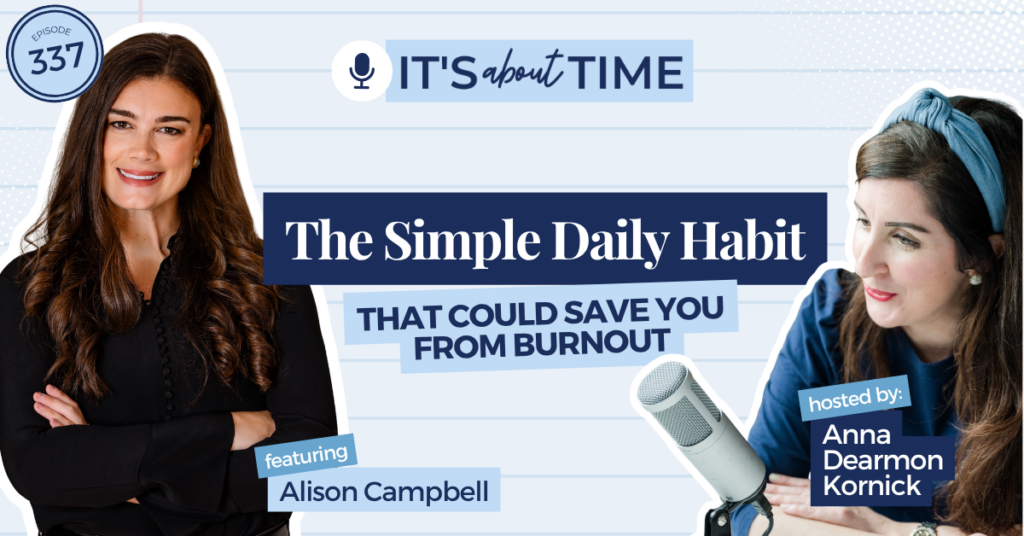
How to Avoid Burnout Without a Playbook with Alison Campbell
Have you ever felt like burnout is just the price you pay for ambition? If you’re building a business, raising a family, or both at once, you already know how easy it is to push through the warning signs instead of listening to them. In this episode, I sit down with Alison Campbell, founder of unBurnt, to talk about what it actually looks like to protect your energy while building something big, even when there’s no playbook to follow.
Key Takeaways
- Track your stress and energy daily so you catch overwhelm before it becomes a crisis
- Use a simple four-step reframe to reset in the middle of a stressful moment
- Let go of the all-or-nothing mindset that says everything needs to be an A-plus
- Recognize when burnout is a “you” problem versus an environment problem
- Build in margin on your calendar before you think you need it, not after
From Corporate Burnout to Founder
Alison spent nearly twenty years building her career across finance, ecommerce, and HR tech, including roles at Morgan Stanley, HSN, Wayfair, and Workhuman. Her last corporate role was Chief of Staff and Head of Strategy and Analytics at a billion dollar SaaS company, working directly with the CEO and board. From the outside, she had made it. On the inside, she was quietly pushing through constant overwhelm until a health scare in 2023 landed her in surgery and forced her to face what she had been ignoring all along.
That recovery became the catalyst for unBurnt, a company built on the idea that almost every burnout intervention targets the individual while the structural conditions that created the burnout go completely untouched. Alison’s approach works at both levels at once, diagnosing where capacity is breaking down inside teams while also redesigning the everyday rhythms that determine whether real change actually holds.
The Daily Check-In That Catches Burnout Early
One of the simplest tools Alison shared is a daily check-in you can run through in under a minute. At the end of the day, ask yourself three questions: What’s my stress level, one to ten? What’s my energy level, one to ten? And what am I actually stressed about? That last question is the key one. Naming the real source of stress, rather than staying stuck in a vague sense of overwhelm, gives you information you can actually act on.
Alison explained that tracking this over a couple of weeks reveals patterns you would otherwise miss. If your stress score keeps landing in the five to seven range day after day, that’s a signal worth paying attention to, long before it turns into full burnout.
The Four-Step Real-Time Reframe
For moments when stress hits in real time, like a tense meeting or a hard conversation, Alison teaches a four-step reframe you can run through in about five minutes:
- Take a deep breath to physically lower your stress response
- Name what just happened, out loud or in writing
- Ask what else could be true, assuming positive intent
- Close the loop with something restorative, like a short walk or a glass of water
This isn’t about suppressing what happened. It’s about processing it fully so you don’t carry it, and layer more stress on top of it, into the next thing on your calendar.
Why “Good Enough” Is Actually the Goal
Alison and I talked about the pressure so many high achieving women carry to be excellent at everything, all the time. Her take is that this isn’t sustainable, and it isn’t even necessary. Making space for a few B-minus efforts is what allows you to show up with real excellence where it matters most. If you’ve ever felt guilty about not giving 100 percent to every single thing on your plate, this conversation is worth revisiting alongside our episode on setting realistic priorities.
When the Problem Isn’t You, It’s the Culture
We also got into a harder question: what do you do when you’re doing everything right personally, but you’re still working inside a culture that runs on burnout? Alison’s advice is to assess the full landscape before deciding what’s next. Is this a busy season with an end in sight, or a chronic pattern? Do you feel safe raising it with your manager? And most importantly, if it is the environment, that is not a personal failure. You cannot be expected to fix a toxic culture on your own.
About the Guest
Alison Campbell is the founder of unBurnt, an SBA-certified Women-Owned Small Business helping leaders and teams address burnout at both the individual and organizational level. She is also an Executive in Residence at Bentley University’s Center for Health and Business, where she leads original research on how modern workplace conditions erode the capacity organizations need for performance and innovation.
Episode Links + Resources
- Free Capacity Score Diagnostic for Leaders
- When Burnout Looks Like Productivity: The New Risk to Innovation Capacity
- Follow Alison on her personal LinkedIn, Instagram, and her company LinkedIn
- Apply for a free time management coaching session: freetimecall.com


Be the first to comment