





LISTEN IN APPLE PODCASTS | LISTEN IN SPOTIFY
How to Get More Deep Sleep When Your Nights Get Interrupted
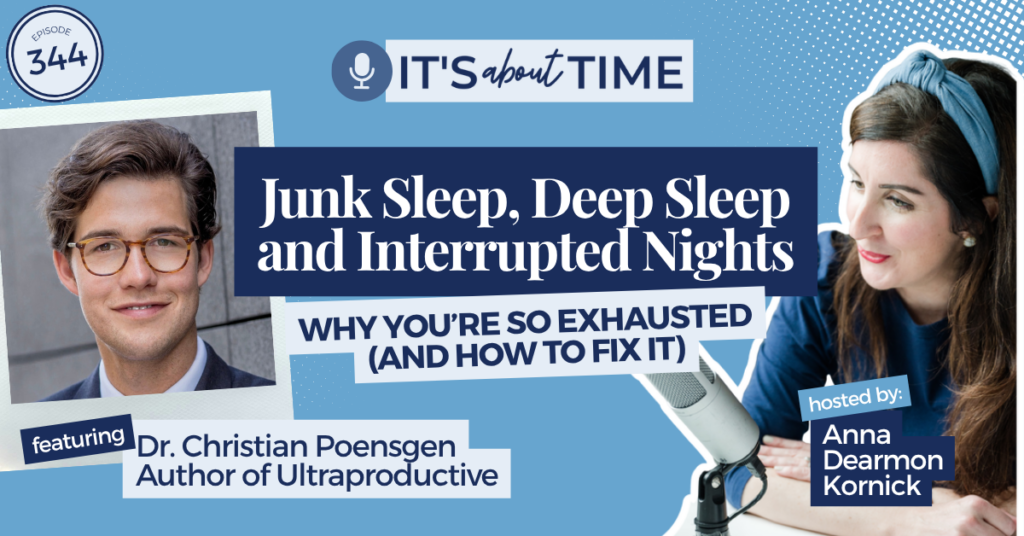
Do you ever get a “full night’s sleep” and still wake up exhausted? You’re not alone. If you’ve been wondering how to get more deep sleep when your nights keep getting interrupted, the answer has less to do with how many hours you log and more to do with what kind of sleep you’re getting. In this episode, I sit down with Dr. Christian Poensgen, scientist, executive coach, and co-author of Ultraproductive, to talk about focus, sleep, and what productivity really means.
Key Takeaways
- Define productivity by intention, not by how busy you are.
- Protect one 30 to 90 minute block of focused time for your most important work.
- Take quiet walks without a podcast or music to give your best ideas room to surface.
- Track deep sleep and REM sleep minutes instead of obsessing over your overall sleep score.
- Finish eating about three hours before bed and try a hot shower to boost your deep sleep.
Productivity Is About Intention, Not Hustle
Christian knows the word “productive” can sound like hustle culture. However, he sees productivity as something very different. In his words, “it’s all about being intentional about what you want to do with your time, and then actually doing it.”
On a workday, that might look like finishing an important presentation and still calling it a day at 6:00 PM to be with your loved ones. On a day off, it might mean spending real time with your family instead of scrolling Instagram.
Protect One Block of Focused Time
Christian spends his mornings writing and creating, then saves calls, meetings, and coaching sessions for the afternoon. He calls these focused blocks “ultra focus sessions,” and he says they’re closely related to Cal Newport’s concept of deep work.
You don’t need a whole morning to make this work. Christian points to a 2013 McKinsey study and says that even one 30, 60, or 90 minute session of deeply focused work on your most important task can roughly double what you get done.
Protecting that time takes clear priorities, time blocking, and a plan for distractions. If you want to build focused time into your mornings, Ep. 19 is a great place to start.
Why Quiet Walks Spark Your Best Ideas
Here’s a surprise: Christian never listens to podcasts on his walks. He’s found that his best ideas, for both work and life, come when he’s moving with no input from other minds.
He also points to a 2014 Stanford study that found creative output goes up 60% when you’re walking.
What Is Junk Sleep?
Christian once slept seven to eight hours a night and still woke up exhausted. When he started tracking, he found he got plenty of REM sleep but not enough deep sleep.
That’s what he calls “junk sleep,” a term he credits to the British Sleep Council. Just like junk food, you get enough of it, but it’s missing the essential macronutrients.
The two macronutrients of sleep are:
- Deep sleep: for the physical recovery of your body and brain. Most of it happens in the first half of the night.
- REM sleep: for emotional recovery. Christian calls it your body’s own overnight therapy. Most of it happens in the second half of the night.
His target is 60 to 90 minutes of each. So a middle-of-the-night wake-up isn’t the disaster it feels like. You’ve likely already banked most of your deep sleep, and REM sleep can still happen once everyone settles back down.
How to Get More Deep Sleep
Because deep sleep happens early in the night, the hours before bed matter most. Christian recommends two simple experiments:
- Stop eating earlier. Your core body temperature needs to drop before deep sleep, and a late or heavy meal gets in the way. Christian finds that finishing your last bite about three hours before bed is a good yardstick.
- Take a hot shower before bed. It sounds backwards, but warming up helps your body cool itself down faster afterward. Christian cites research shared in Matthew Walker’s Why We Sleep showing a hot shower before bed can increase deep sleep by up to 50 minutes.
Not sure you’re getting enough? When you wake up, rate your energy from 1 to 10. Christian says an 8 or higher is a good sign.
Waking Up Groggy? Try the 90-Minute Rule
That foggy feeling is called sleep inertia, and it happens when your alarm pulls you out of a deeper sleep phase. Christian suggests sleeping in multiples of 90 minutes, like 6, 7.5, or 9 hours.
About Dr. Christian Poensgen
Dr. Christian Poensgen is a scientist turned entrepreneur, writer, and executive coach. He holds a PhD (summa cum laude) on the relationship between stress and performance. He has spent decades turning research in neuroscience, physiology, and psychology into practical systems that help ambitious people perform at a high level without compromising their health or well-being. Christian has served as Senior Fellow of the “Future of Work” think tank in the German Federal Parliament, as Co-Founder and Director of the European Center for Digital Competitiveness at ESCP Business School, and as an Agenda Contributor at the World Economic Forum. He and Eric Partaker are co-founders of Ultra Labs and co-authors of Ultraproductive: The 90-Minute Method to Optimize Focus, Sleep, and Stress.
Episode Links + Resources
- Ultraproductive book website
- Connect with Christian on LinkedIn
- Connect with Eric Partaker on LinkedIn
- Ultra Labs
- Rise app
- Anna’s Rise sleep screenshot [add image]
- Oura Ring
- Why We Sleep by Matthew Walker
- Deep Work by Cal Newport
- Thrive by Arianna Huffington
- Peak Performance by Brad Stulberg and Steve Magness
- Apply for a free time management coaching session


Be the first to comment