





How to set boundaries
LISTEN IN APPLE PODCASTS | LISTEN IN SPOTIFY
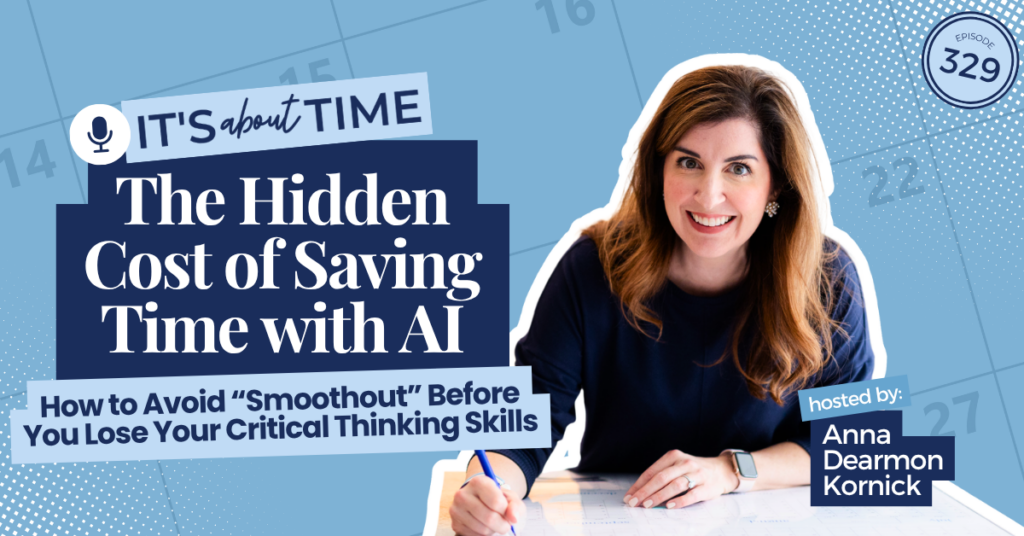
AI and Critical Thinking Skills: Are You Losing Your Edge?
Have you found yourself reaching for ChatGPT the second something feels even a little bit hard?
You are not alone, and there is actually a brand new term for it.
A journalist named Ellen Scott just coined the word “smoothout” to describe what happens when we hand over every challenge to AI. It raises a real question about AI and critical thinking skills: are we saving time at the expense of the skills we still need? In this episode, I am breaking down what smoothout is, why your brain actually craves a little friction, and how to stay intentional about what you hand over to AI and what you hold onto.
Key Takeaways
- Recognize what smoothout is and how it differs from burnout or boreout
- Understand why your brain craves challenge and what “eustress” has to do with it
- Identify the difference between using AI as a launchpad versus using it to avoid discomfort
- Apply a simple set of questions to ask yourself before reaching for AI on your next task
- Protect the skills that matter most to you, even while using AI every day
What Is Smoothout?
Smoothout is a term coined by journalist Ellen Scott, who was also the first to write about “quiet quitting” back in 2022. She introduced the term in her 2026 work trends predictions to describe the mental impact of increasingly over-relying on AI. It is rooted in the same language as burnout and boreout, but it is distinct to this exact cultural moment, when more and more of us reach for generative AI the instant we face anything remotely challenging.
The concern is not really about AI being bad. It is about which decisions and tasks we are quietly outsourcing, and what we lose in the process.
Why Your Brain Needs a Little Friction
Researchers have a term called “eustress,” which is good stress, the kind that shows up when you are working through something mentally difficult. That friction is not a flaw in the system. It is actually how we build mastery, confidence, and sharper judgment over time.
When AI smooths every hard moment out before we have even tried, we are not just saving time. We may be losing the mental reps that keep our thinking sharp.
AI and Critical Thinking Skills: Where the Line Actually Is
This is not an episode about quitting AI. I use it every day, and I am not going to stop. A great example of AI used well is the Instagram creator Upgrading Katie, who is spending a year building her dream life one AI-generated to-do list at a time. Using AI as a way into a topic you do not know much about yet is a smart use of the tool.
Smoothout shows up somewhere different: in the tasks we already know how to do, or could learn to do, if we just sat with the discomfort for a minute. The hard email. The tricky decision. The problem we could work through ourselves if we let ourselves get a little stuck first.
Think of it this way. Let’s say your job never requires you to speak Spanish. So you stop practicing. That is fine day to day, but then you take a trip or family is in town, and suddenly you need that skill, and it is just not there anymore. Not because you could not do it once. Because you stopped getting the reps in.
A Few Questions to Ask Before You Reach for AI
Instead of a strict framework, here are a few honest questions to sit with this week:
- Is this something I actually know how to do, or am I avoiding the discomfort of figuring it out?
- Am I using this to get unstuck, or to avoid starting in the first place?
- If I let AI handle this every time, what skill am I quietly letting go rusty?
There is no perfect answer. Some days the honest answer is that you simply do not have the bandwidth, and that is okay. Other days, it is worth noticing if you are avoiding something you are fully capable of doing yourself.
Episode Links and Resources
Related Episodes
Frequently Asked Questions
What is smoothout? Smoothout is a term coined by journalist Ellen Scott to describe the mental impact of increasingly over-relying on AI. It describes what happens when we hand over every challenging task to AI so consistently that we slowly lose the critical thinking skills we still need in other areas of our lives. Ellen Scott also coined the phrase “quiet quitting” in 2022.
Is smoothout the same as burnout? No. Burnout comes from doing too much. Smoothout is the opposite — it comes from doing too little of the hard mental work, because AI is doing it for us. The concern is not exhaustion but gradual disengagement and a quiet erosion of skills like problem-solving, decision-making, and independent thinking.
Does using AI hurt your critical thinking skills? Research suggests that over-relying on AI for cognitive tasks can weaken critical thinking skills over time, through a process researchers call “cognitive offloading.” This does not mean AI is bad — it means being intentional about which tasks you hand over matters. Using AI as a launchpad into something new is very different from using it to avoid tasks you are already capable of doing.
What is eustress and why does it matter for productivity? Eustress is the term researchers use for “good stress” — the kind that comes from working through something mentally challenging. Unlike distress, eustress is beneficial. It is how we build mastery, confidence, and stronger judgment over time. When AI removes that friction before we have even tried, we may be skipping the mental reps that keep our thinking sharp.
How do I know when to use AI and when to do something myself? A few honest questions can help. Ask yourself: Is this something I already know how to do, or am I just avoiding the discomfort? Am I using AI to get unstuck, or to avoid starting? If I let AI do this every time, what skill might I be letting go rusty? There is no perfect answer, but noticing the choice you are making is the first step.
What is the difference between saving time with AI and losing your edge? Saving time with AI is a smart use of the tool, especially for tasks outside your expertise or for repetitive busywork. Losing your edge happens when you consistently outsource tasks that require the very skills you need to stay sharp: critical thinking, judgment, problem-solving, and decision-making. The goal is not to quit AI — it is to be intentional about what you protect.


Be the first to comment