





How to set boundaries
LISTEN IN APPLE PODCASTS | LISTEN IN SPOTIFY
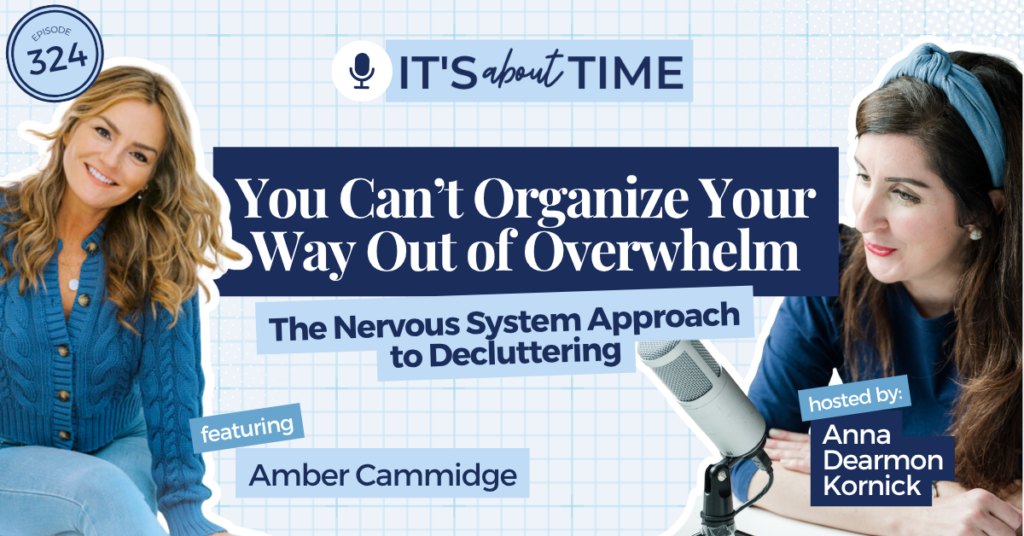
Declutter Your Home with Amber Cammidge
Does your home feel more chaotic than calm at the end of a long day? If you’ve ever stood in the middle of a cluttered room with no idea where to start, you’re not alone — and you’re not failing. In this episode, I sit down with home clarity coach Amber Cammidge to explore why decluttering your home starts from the inside out, and how tiny, intentional actions can transform your space into the sanctuary it was always meant to be.
Key Takeaways
- Recognize clutter as a nervous system issue, not just an organizational one
- Apply Amber’s Body, Mind, Soul + Next Action framework to your home
- Start smaller than you think — tiny daily actions beat big decluttering projects every time
- Shift your identity from overwhelmed to empowered by reframing what clutter says about you
- Build a simple morning routine that sets the tone for a calmer home and a calmer day
Why Decluttering Your Home Starts With You
We tend to blame our homes for the way we feel. Too much stuff, not enough systems, not enough time. But what Amber and I unpack in this conversation might surprise you — because the real barrier to a clutter-free home isn’t your closets. It’s your nervous system.
When you walk into a cluttered room, your body responds before your brain does. Your shoulders tighten. Your mind goes blank. You think, “I don’t even know where to start,” and so you don’t. Amber calls this a dysregulated state — and she teaches her clients that no amount of bins, baskets, or label makers will create lasting change until you address what’s happening on the inside first.
The good news? Regulation doesn’t have to take long. Even one minute of intentional breathing can shift your body out of overwhelm and into a state where action feels possible.
The Body, Mind, Soul + Next Action Framework
Amber teaches her clients through a four-part framework that addresses every layer of the decluttering experience:
Body — How does your physical space make you feel? Clutter creates tension in the body. Before you do anything, regulate your nervous system with a few deep, intentional breaths. Feel your feet on the floor. Come back to the present moment.
Mind — Your mind sees the whole room and immediately says “impossible.” Amber’s fix? Shrink the scope. Instead of tackling an entire space, focus on the tiniest area in front of you. A few items. One small win. That’s enough.
Soul — This is where identity comes in. Clutter isn’t a character flaw. It accumulates during the busiest, hardest seasons of life — babies, loss, divorce, transitions. Reframing what your clutter says about you — from “I’m a mess” to “I’ve been doing so much” — is what makes lasting change possible.
Next Action — With your body calm, your mind focused, and your identity intact, the next step becomes clear. What is the tiniest action you can take right now? Not the whole project. Just the next thing.
Why Tiny Actions Beat Big Decluttering Projects
One of my favorite moments in this conversation is when Amber talks about how decluttering is a lifestyle, not a one-time event. We’ve all had the experience of spending an entire Saturday going through closets, feeling amazing — and then watching the clutter creep back within weeks.
That’s because big projects don’t build habits. Tiny daily actions do.
Making your bed in the morning. Putting one thing away before you leave a room. Taking a single deep breath before you walk through the front door. These small, consistent choices compound over time into a home — and a nervous system — that feels genuinely different.
As I always say on this show, it’s not about perfection. It’s about progress. And even the smallest step moves you forward.
Decluttering as a Form of Self-Care
Perhaps the most powerful reframe in this episode is this: decluttering your home is an act of self-care. Not a chore. Not a project. A practice of coming back to yourself.
Amber shares how her own journey — through a full-time teaching career, a divorce, and a spiritual awakening — taught her that inner clarity always precedes outer order. When you prioritize your own regulation, your own peace, your own sense of identity, the home follows. Not perfectly. Not all at once. But steadily, beautifully, and in a way that actually lasts.
If you’ve been waiting for the “right time” to tackle the clutter in your home, this episode is your sign that the right time starts with you — right now, exactly as you are.
About Amber
Amber Cammidge is a home clarity coach on a mission to help women transform their homes into true sanctuaries — not through perfect organization, but through inner clarity, nervous system regulation, and intentional daily action. Her Body, Mind, Soul + Next Action framework helps clients move through overwhelm and into a home — and a life — that finally feels like their own. Amber works with clients through a weekly group program and her own podcast.
Episode Links + Resources
- Visit Amber’s website: https://declutteryourchaos.com/
- Follow Amber on Instagram: @ambercammidge
- Listen to Amber’s Podcast: Declutter Your Chaos
- Power vs. Force by David R. Hawkins
Related Episodes
Ep. 294 – The Real Reason Why Decluttering Feels So Hard (Hint: It’s Not the Stuff)
Frequently Asked Questions
What is the connection between clutter and the nervous system?
Clutter triggers a stress response in the body before you’ve even made a conscious decision about it. When you walk into a cluttered space, your nervous system registers it as overwhelm, making it harder to think clearly or take action. Regulating your nervous system first — through breathwork or simple grounding practices — makes decluttering feel far more manageable.
How do I start decluttering when I don’t know where to begin?
Start smaller than you think. Rather than tackling an entire room, choose the tiniest area in front of you and focus only on that. Move a few items to where they belong, throw away what needs to go, and stop there. That one small win is enough to build momentum for the next action.
Why does clutter keep coming back even after I organize?
Because organization alone doesn’t address the root cause. Clutter often accumulates during busy or difficult seasons of life, and without addressing the emotional and identity layers underneath it, external systems won’t stick. Sustainable change comes from building small daily habits and shifting how you see yourself in relation to your home.
What is the Body, Mind, Soul + Next Action framework?
It’s a four-part approach developed by home clarity coach Amber Cammidge that addresses every layer of the decluttering experience. Body focuses on nervous system regulation, Mind narrows your focus to a manageable scope, Soul reframes your identity and relationship to your clutter, and Next Action identifies the smallest possible step you can take right now.
Can decluttering really improve my time management?
Yes — because a calmer home creates a calmer mind, and a calmer mind makes better decisions with time. When your environment is chaotic, every room becomes a source of mental load and decision fatigue. Reducing that friction through small, consistent home habits directly frees up mental energy for the things that matter most..


Be the first to comment