





How to set boundaries
LISTEN IN APPLE PODCASTS | LISTEN IN SPOTIFY
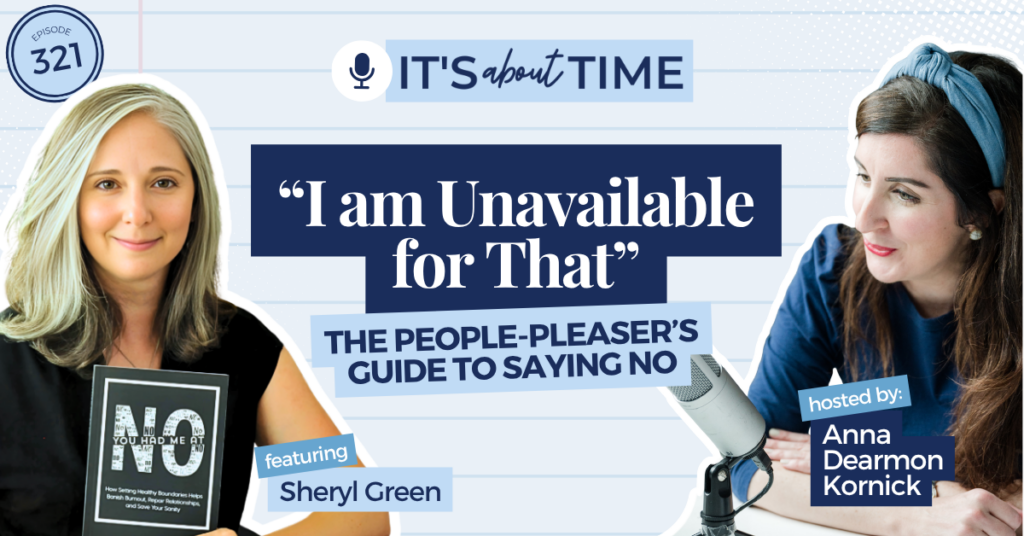
How to Say No Without Guilt: Setting Boundaries with Sheryl Green
Have you ever said yes to something and immediately felt that sinking feeling in your stomach — like some part of you already knew the answer should have been no? If saying no feels nearly impossible, you are not alone — and you are not broken. Learning how to say no is one of the most powerful things you can do for your time, your relationships, and your well-being. In this episode, Anna sits down with speaker, author, and boundary expert Sheryl Green to talk about why boundaries are so hard, how to find your invisible lines, and how to finally get the word “no” out of your mouth without the guilt spiral that usually follows.
Key Takeaways
- Boundaries are hard because most of us were never taught them — and that is not your fault
- You can find your invisible boundaries in your body and in your memory
- Naming what you are unavailable for gives you a powerful filter for every future interaction
- The “rearview mirror” technique helps you identify where boundaries need to be set
- Saying no is always going to feel uncomfortable — and that is completely okay
Why Boundaries Feel So Impossible
Most of us were never taught how to set boundaries growing up. In fact, many of the messages we received as children — go hug Aunt Sally, share your toys, don’t make waves — quietly trained us to put everyone else’s needs above our own. Sheryl explains that those early messages don’t just disappear when we reach adulthood. They show up in our people-pleasing, our overcommitment, and our inability to say no even when every part of us is screaming that we should.
As a time management coach, Anna sees this play out constantly. Many of the women she works with come to her thinking they have a time management problem — only to discover that what they actually have is a boundary problem. When we say yes to everything and everyone around us, there is simply no time left for what matters most. If you have been struggling to protect your time, it may be worth asking whether the real issue is not your calendar — it’s your boundaries.
How to Find Your Invisible Boundaries
Sheryl describes boundaries as invisible lines — you know they exist, but they can be hard to see in the moment. The good news is that your boundaries are findable. Sheryl shares two places to look.
The first is your body. That tightening in your chest, the lump in your throat, the whole-body “nope” that shows up before your brain has even processed the situation — that is your boundary talking. Learning to tune back into those physical signals is one of the most powerful things you can do. Sheryl shares a personal story about a suspicious furniture buyer on Facebook Marketplace that perfectly illustrates how listening to that gut feeling can save you — in more ways than one.
The second is your memory. Sheryl calls this the “rearview mirror” technique. We tend to face the same situations over and over again — the players change, but the pattern stays the same. When you look back at the moments that didn’t sit right, you can identify exactly where your boundary was crossed. And when that situation shows up again — and it will — you’ll be ready.
For a practical way to put this into action, Anna recommends writing your boundaries down. Putting your yeses and nos into actual words — “I leave work by 6pm,” “I am not taking on any new committee requests this season” — makes them feel real. Think of it as a contract with yourself. When the moment comes and your boundary is being tested, you have already made the decision. You just have to follow through.
Name What You Are Unavailable For
One of the most memorable moments in this conversation is when Sheryl shares the concept of declaring what you are simply unavailable for. Instead of trying to anticipate every situation that might push your limits, you name the category. “I am unavailable for condescension.” “I am unavailable for guilt.” When you have that filter in place, you can run interactions through it in real time — and respond thoughtfully instead of reacting in the moment or kicking yourself three days later.
Sheryl also shares a brilliant phrase borrowed from attorney and communicator Jefferson Fisher for when something lands wrong: “Did you mean for that to come out that way?” It is calm, it is clear, and it puts the responsibility right back where it belongs — without burning the relationship to the ground.
How to Actually Say No
Here is the honest truth that Sheryl and Anna land on together: saying no is hard. It is always going to be hard. The discomfort does not fully go away — and the sooner you accept that, the easier it becomes to push through it anyway. The goal is not to make saying no feel effortless. The goal is to recognize that the temporary discomfort of saying no is always better than the ongoing cost of saying yes to the wrong things.
Sheryl also introduces the idea of seasonal boundaries — knowing what you are saying yes and no to based on the season of life you are currently in. She shares how during her current writing season, she has said no to her weekly hiking dates, early morning commitments, and anything that pulls her focus before she hits her writing goals for the day. But it is not no forever. It is no for now — and knowing the difference is everything.
About Sheryl Green
Sheryl Green has taken people-pleasing to — in her own words — Olympic levels. For decades, she put everyone else’s needs above her own until she hit a metaphorical brick wall. After committing to one too many responsibilities, she discovered the importance of boundaries — and that boundaries were even a thing in the first place. Now she works with individuals and organizations to establish healthy boundaries that improve relationships, communication, and overall well-being. Sheryl holds a Master’s Degree in Forensic Psychology and is the author of six books, including You Had Me at ‘No’: How Setting Healthy Boundaries Helps Banish Burnout, Repair Relationships, and Save Your Sanity.
Episode Links and Resources
- Learn more about Sheryl Green
- Connect with Sheryl on LinkedIn and Instagram
- Sheryl’s book: You Had Me at ‘No’
- Get Sheryl’s FREE You Had Me at ‘No’ Cheat Sheet
- How to set up Google Chrome tab groups
- Apply for a free time management coaching session: freetimecall.com
Related Episodes
- Ep. 265 – The Art of Saying No: How to Hold Boundaries and Create an Intentional Life ft. Rachel Closson
- Ep. 218 – The Secret to Better Boundaries: How Clear Communication Can Radically Change the Way You Manage Your Time featuring Blair Broussard
- Ep. 114 – Better Boundaries and Being Present: How to Set Boundaries and Be More Present During Your Downtime
Frequently Asked Questions
Why is it so hard to say no? Saying no is hard for most people because they were never taught how to set boundaries growing up. Early messages — like being told to share, to hug relatives, or to avoid conflict — quietly trained us to prioritize everyone else’s comfort over our own. As adults, that people-pleasing shows up as an inability to say no even when we desperately want to. The good news is that boundaries can be learned at any stage of life.
How do I know where my boundaries are? Boundary expert Sheryl Green suggests looking in two places: your body and your memory. Physical signals like a tight chest, a lump in your throat, or a gut feeling of “this isn’t right” are often your boundaries speaking before your brain catches up. Your memory is equally powerful — look back at situations that left you feeling resentful, drained, or frustrated. Those moments reveal exactly where a boundary needed to be.
What is the “rearview mirror” technique for boundaries? The rearview mirror technique, developed by Sheryl Green, involves looking back at past situations where you felt uncomfortable, overcommitted, or taken advantage of. Because we tend to face the same patterns repeatedly, examining what happened in the past helps you identify your boundaries — so that when a similar situation arises again, you are prepared to respond differently.
How do I set boundaries without feeling guilty? Guilt is a normal part of the boundary-setting process — especially for people who have spent years prioritizing others. Sheryl recommends starting by naming what you are unavailable for, which creates a mental filter that makes it easier to respond in the moment. Anna also recommends writing your boundaries down as a kind of contract with yourself, so the decision is already made before the moment of pressure arrives.
What are seasonal boundaries? Seasonal boundaries are boundaries that are tied to a specific season or phase of life rather than being permanent rules. For example, during a season of writing, Sheryl says no to early morning commitments and social events that pull her focus — but those boundaries shift once the season ends. Recognizing which season you are in helps you set boundaries that are realistic, flexible, and sustainable.
How do I respond when someone crosses my boundary? Sheryl recommends a calm, disarming phrase: “Did you mean for that to come out that way?” This technique, inspired by communicator Jefferson Fisher, gently puts the responsibility back on the other person without escalating the situation. It creates space for them to course-correct — and gives you a moment to respond thoughtfully rather than react in the heat of the moment.


Be the first to comment